20X – Why I'm So Insanely Productive with AI
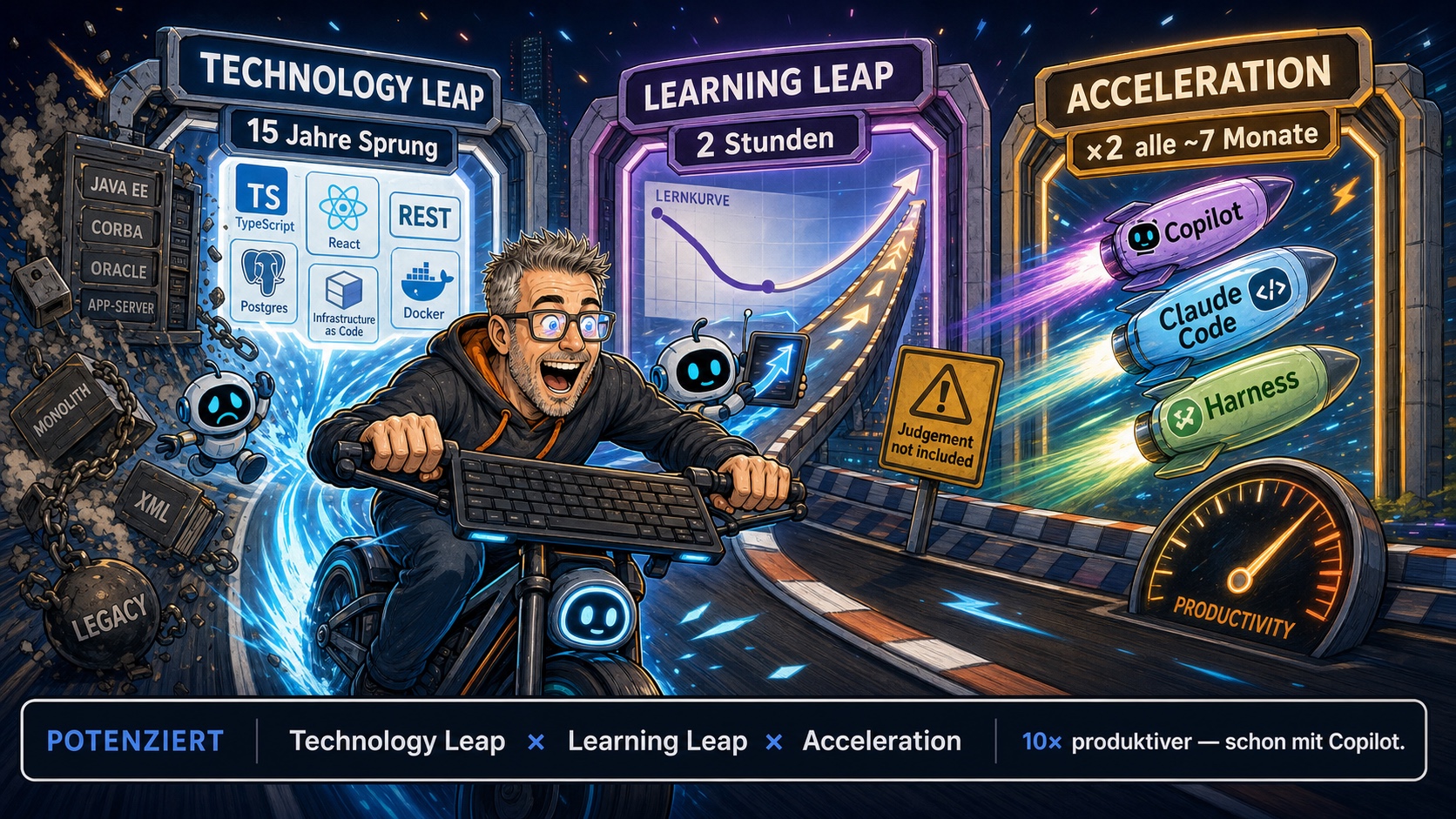
For fifteen years I hadn’t built software myself. When I quit, we were wrangling Java EE, CORBA, Oracle, and spacer GIFs to hold the web frontend together. If you still remember those, you’ve been around a while too 🤓 When I came back a year ago, what had become technically possible outran my wildest dreams. And I have never learned and shipped as fast as I do now.
“20X more productive” sounds like a sales brochure. Like magic. It’s the opposite of magic: it’s a multiplication. Once you know the factors, you understand why the result comes out so large.
A bicycle for the mind
Steve Jobs loved to tell the story of a study: of all creatures, the condor is the most efficient at getting from A to B, measured in energy per distance. Humans rank far down the list — until you put one on a bicycle. Then they beat everything. The bicycle doesn’t make your legs stronger. It turns every push into more distance. A tool that doesn’t add power, but multiplies its effect. That’s why Jobs called the computer “a bicycle for the mind.”
AI-native software engineering is probably the e-bike in that metaphor. Three forces mesh together.
1. Technology Leap
Start with the tools you actually build with. What’s possible today with TypeScript, Node, React, and Docker is simply staggering. A fully typed stack from the backend all the way into the frontend, UIs assembled from reusable components, and for almost every problem the ecosystem already holds a clean solution. Where spacer GIFs once held the frontend together, I now describe declaratively what should be on the screen, and there it is.
And operations, which used to demand a whole engineering team — load balancers, endless scaling debates, a DMZ you could get lost in — is one click today: scale Docker containers horizontally as far as I want, make a PostgreSQL database highly available without calling anyone. What was a team of specialists yesterday is a checkbox in a dashboard today. I run the entire infrastructure of the beacon platform at the provider of my choice — not alone, of course, but with my beacon crew. The technology hasn’t simply gotten “better.” This is a whole new paradigm.
2. Learning Leap
On top of that foundation, I learn faster than I ever could. When I wanted back into code, I watched my friend Marco over his shoulder for two hours, and that was the entire onboarding. My biggest worry was having to relearn all the frameworks and the whole layer of glue code first. Not even close: Copilot took exactly that off my hands. Within a day or two I had a complete ETL process and its backend standing, written in Python, a language I had never written a single line of code in before. From my earlier life I knew how to build clean software architecture. Semantics are what count. Syntax is interchangeable.
But the real aha moment came later. We built a product that guides client advisors through a structured investment-advisory process. It was all about wiring up complex financial interfaces, and suddenly I caught myself discussing financial processes with the agent. That’s when it finally clicked: this thing understands context. First AI took the glue code off my hands, then it helped me onboard into the business context. And it delivered the test data right along with it, at a quality I hadn’t seen before. What used to require an entire test-data anonymization framework now takes a single prompt. Test data management is solved forever.
I haven’t gotten smarter, the feedback loop has collapsed: where days used to sit between question and answer, there are now seconds. Every loop is a lesson, and I run more of them in a day than I used to in a month.
3. Acceleration
And the AI models themselves are getting dramatically more capable, measurably so. METR measures how long a task can be for an agent to still solve it reliably: the task horizon. That horizon doubles roughly every seven months, and has for six years straight. On SWE-bench Verified, a benchmark built from real GitHub issues, models solved about two percent of tasks in 2023. In 2025 it’s over seventy. That’s not an improvement, that’s a different state of matter. And the gap between two model generations keeps shrinking.
My own experience bears that out. When I started with Copilot nine months ago, I was often still tearing my hair out. Then Claude arrived, and a new world opened up. Today, with the full AI-native support of the beacon platform, my productivity feels like it has tripled again compared to my first prompts.
Why the result is so large
This is where “20X” stops sounding like an exaggeration. These three forces don’t add up, they multiply. Since my first Copilot prompt I’m roughly ten times faster: Learning Leap and Acceleration stacked on top of each other, call it three times three. Add the Technology Leap — the jump from the Java EE era to today’s stack — and another factor of about two goes on top. Multiplied, that’s twenty. Added, it would be eight.
That’s exactly why I have never learned and built as fast as I do now. Not because of one brilliant prompt, but because three levers pull at the same time.
The flip side of multiplication
But multiplication has no sign. It amplifies the right direction as forcefully as the wrong one. Anyone building in the wrong direction at compounded speed just arrives at the wrong place faster. The rush from “I am addicted” has its blind spot exactly here. The larger the factor, the more expensive the mistake.
That’s why the e-bike alone isn’t enough. It takes someone to steer, and a structure that keeps it on course: verifiable results instead of blind trust, clear contracts between human and agent. That’s the core of beacon platform — not to ride slower, but to point the multiplied force in a direction that pays off.
What that looks like in practice, I’ll keep telling in this series: AI-native software engineering, one post at a time, on this channel.