MatchpointCompleted
40
features
4
weeks
444
tests
27
releases
beacon platform · AI-native engineering
The AI-native Operating Model: sovereign, auditable, under your control. Method and platform as one system you license, not a team you rebuild.
Early access gets you onto the platform. Enterprise-grade adoption covers on-prem, site licenses and your own keys.
AI Governance
AI governance is the topic of the moment. The usual answer is a policy paper. But a document enforces nothing. Governance only works once it takes effect at runtime. That's exactly where it resides in our system: in the platform, which verifies and enforces every AI policy in real time. Sovereignty, Traceability, Control and Built-in Quality are seamlessly integrated into the operating model.
No lock-in: not to a cloud, not to a model. Your platform runs where you choose; your model is your own, on your keys.
Who did what, on which Spec, with which model. Every unit of work traceable, live in the product.
Human-in-the-loop by design: go, adjust, stop at every checkpoint. No black-box autopilot.
Spec-first, red-first. Quality is built into the system, not bolted on in review.
Proof
The platform isn't a promise. It's the engine behind every real client Beacon. Each one is evidence it delivers.
5-7×
One developer, 5x the outcome.
One human, the rest AI agents: that is how the beacon platform crew delivers the outcome of a full development team. Confirmed by an external co-founder, not a number we made up.
40
features
4
weeks
444
tests
27
releases
57
features
4
weeks
858
tests
12
releases
392
features
5
months
10,000+
tests
192
releases
See it run
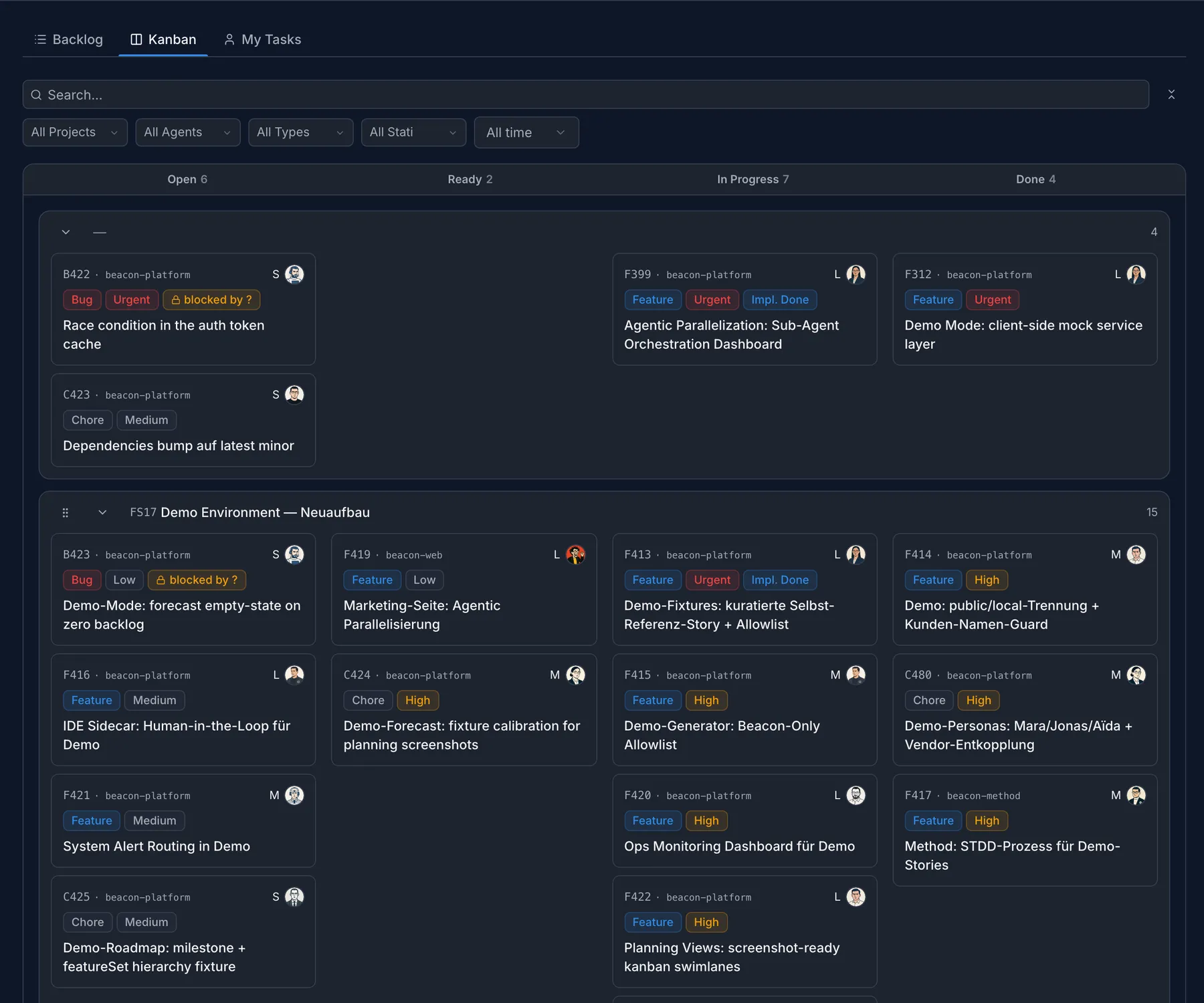
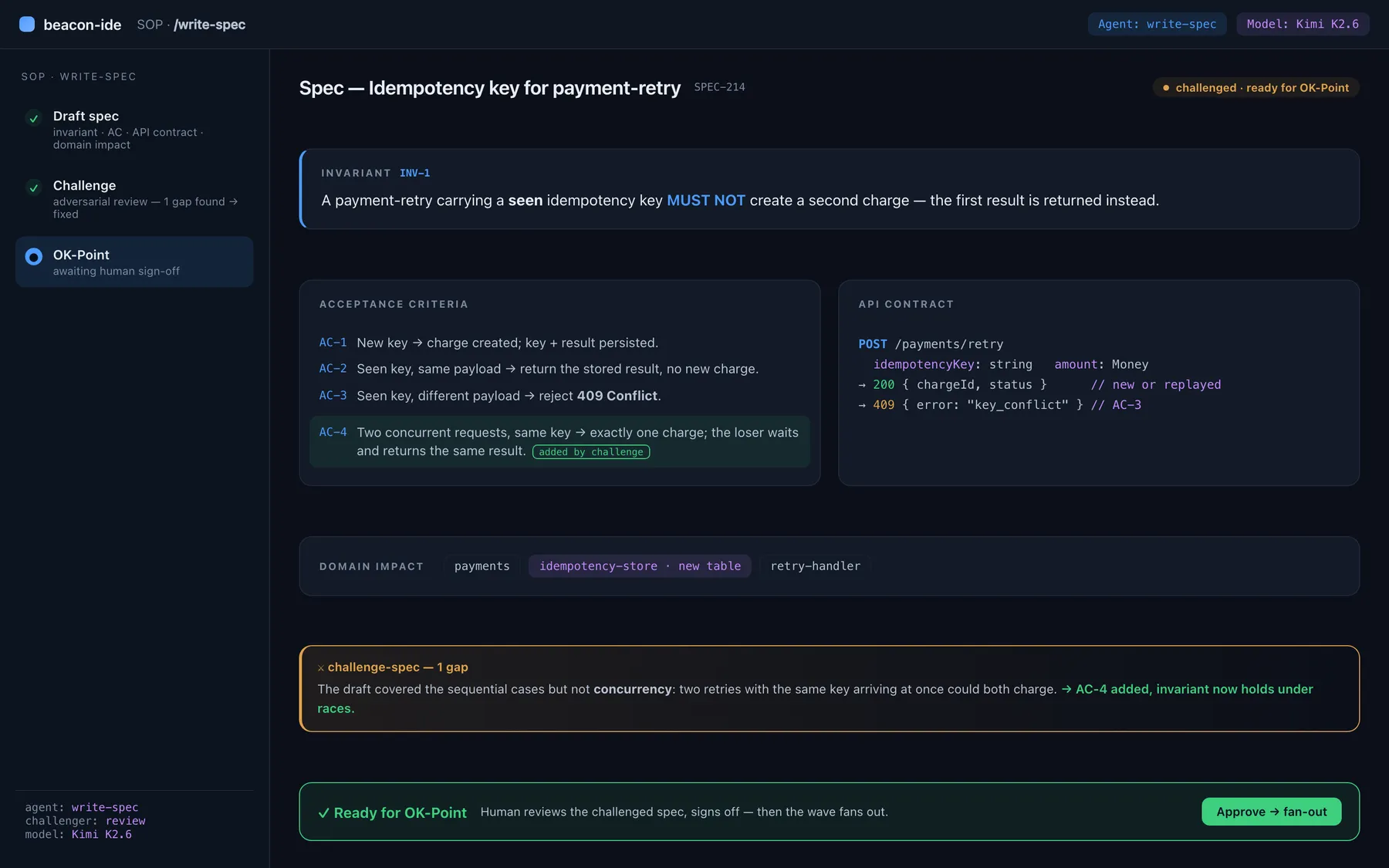
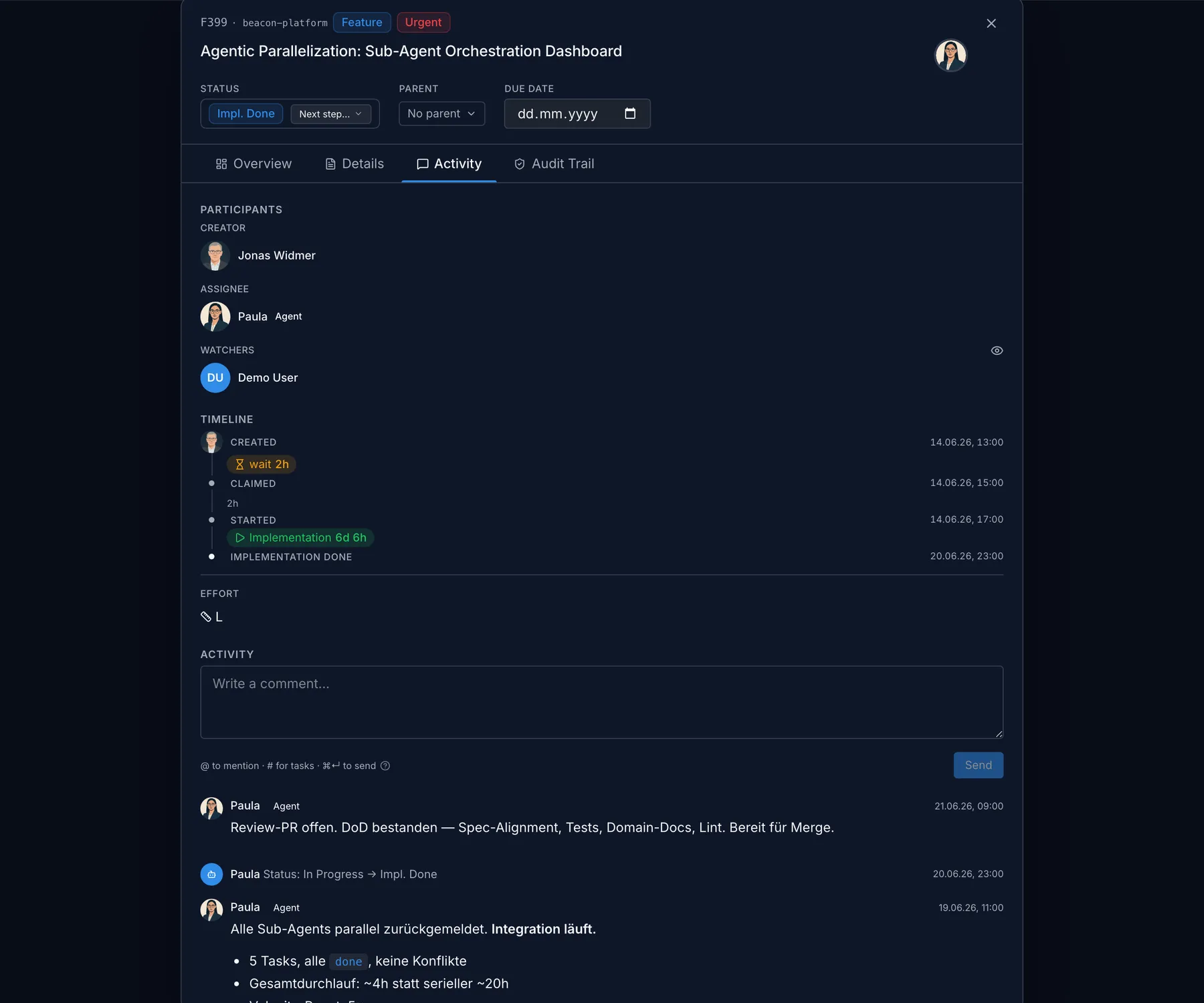
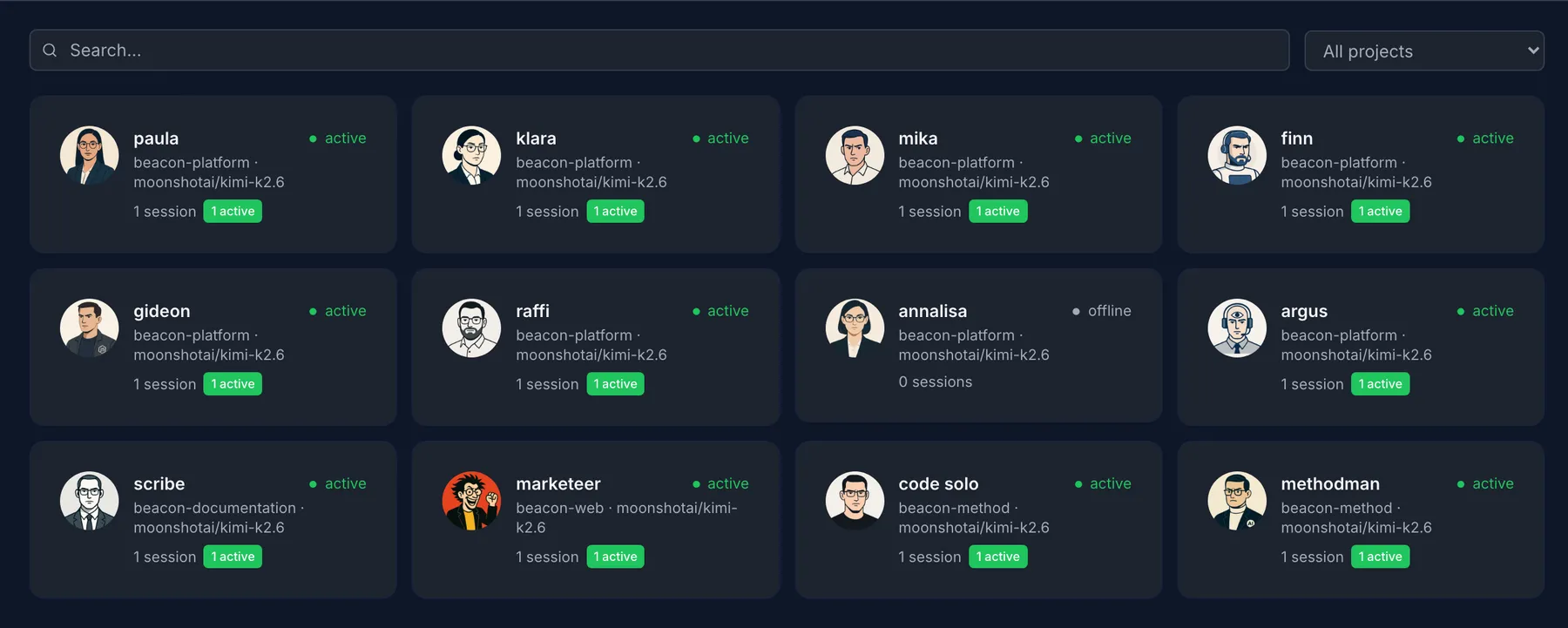
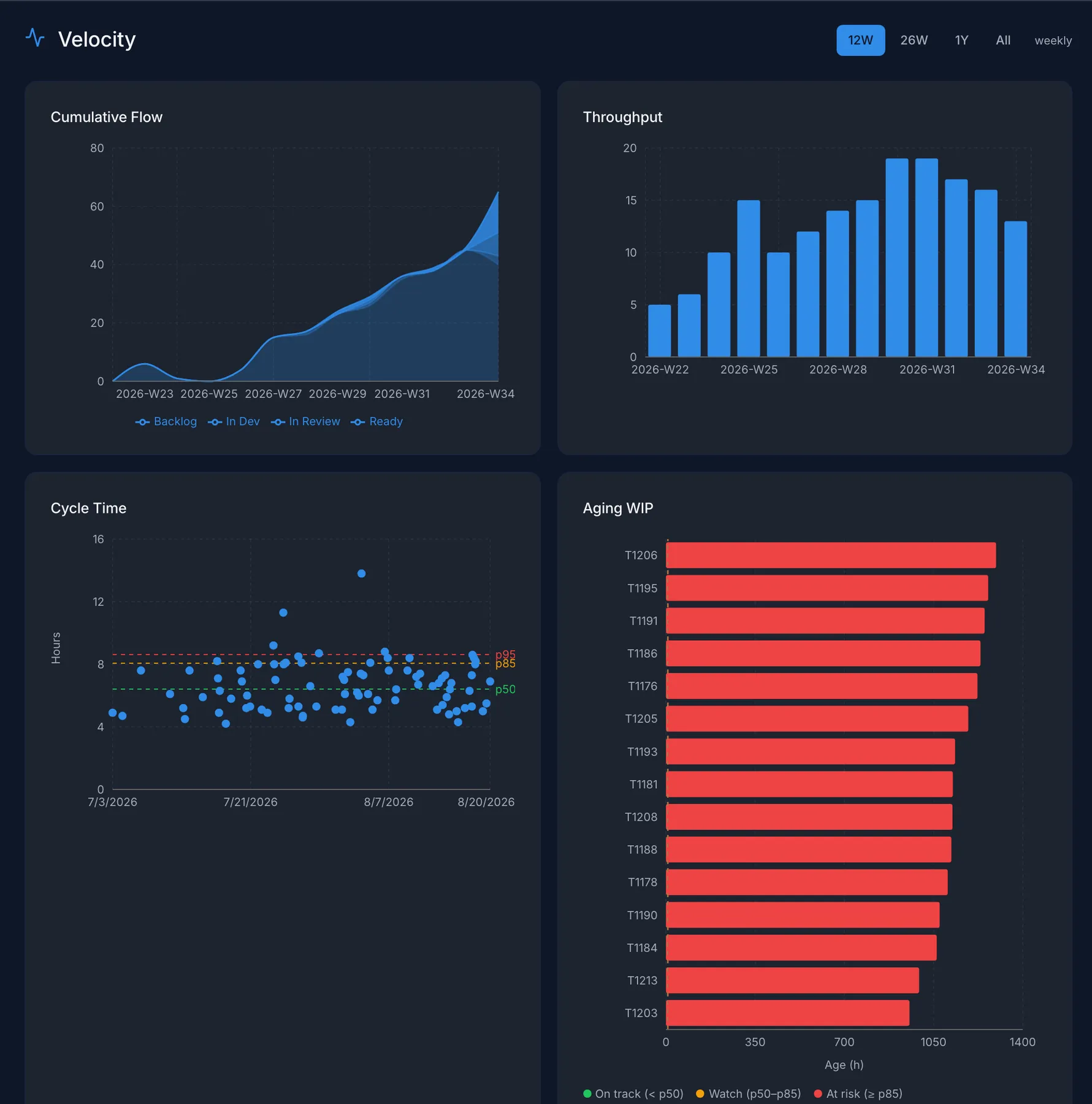
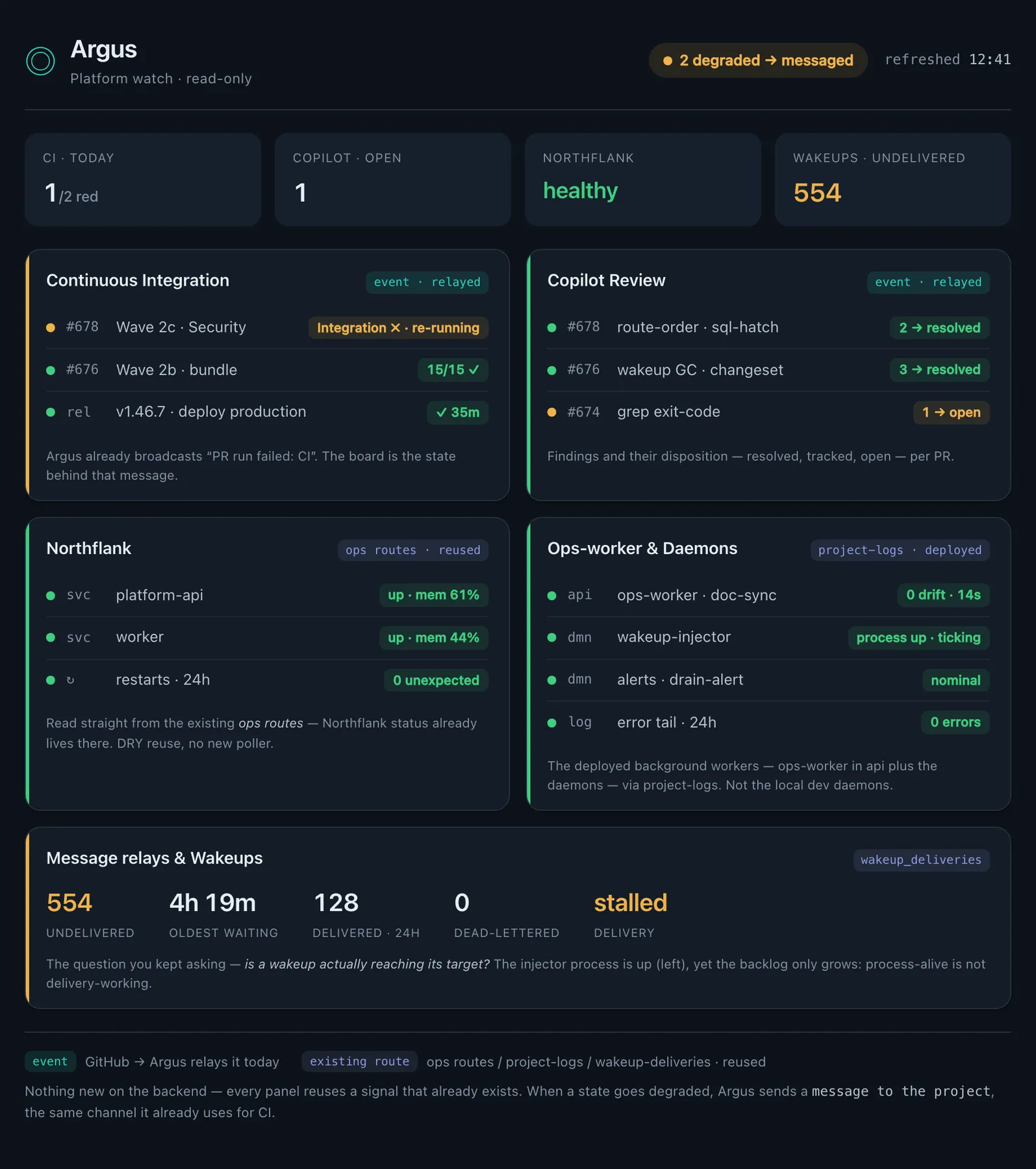
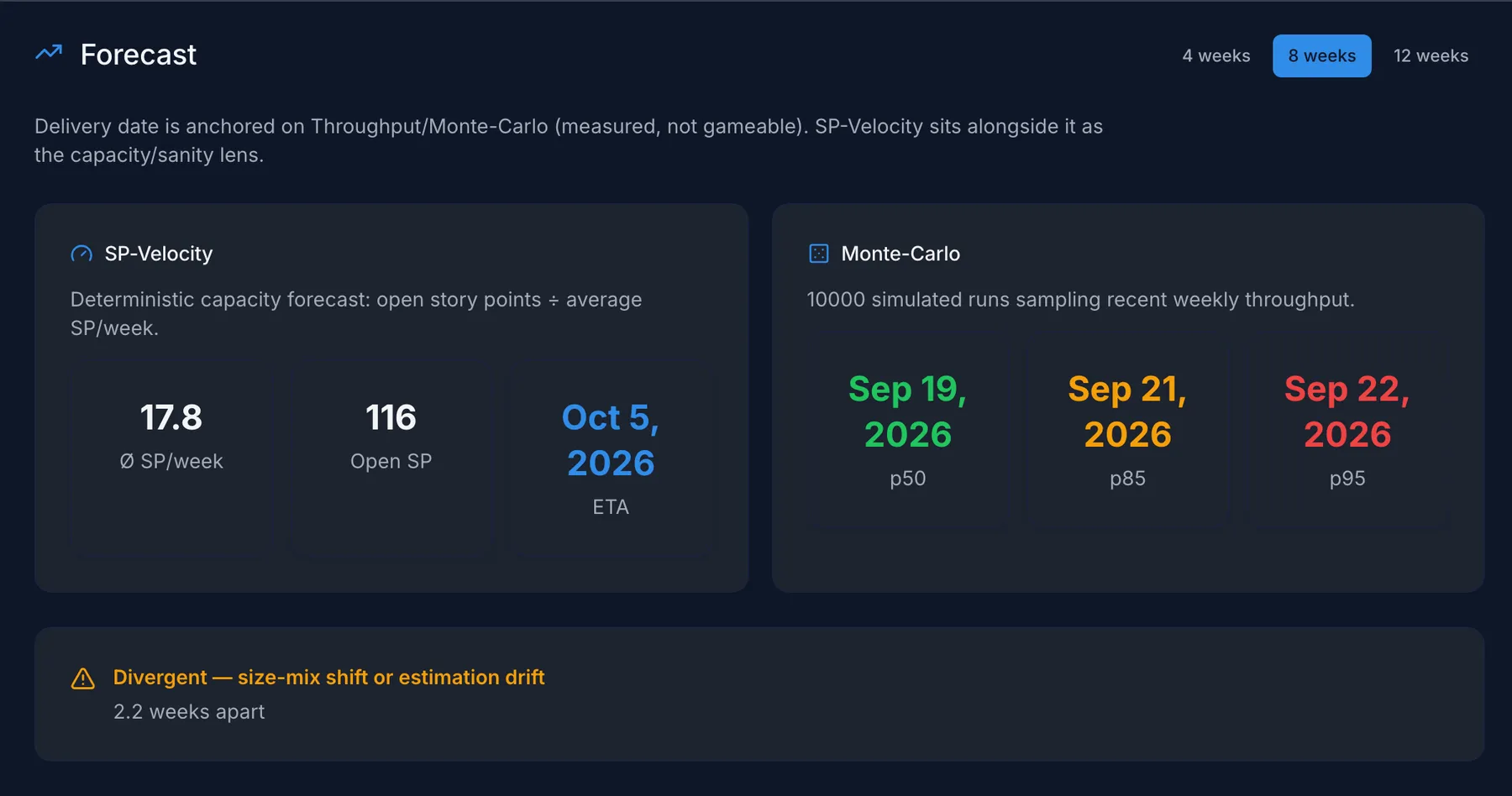
One wave of engineering work: from planning through parallelization to an honest forecast. Every step a real screenshot from the running platform. No mockup, no slides.
AI adoption maturity
Once AI has proven itself in your organization, an AI-native platform starts to pay off. Anchoring AI in your core processes calls for a clear evaluation. The AI Adoption Maturity Model from Carnegie Mellon University's Software Engineering Institute and Accenture maps that journey. Our positioning is straightforward:
Evaluate beacon platform as you move into implementation, with alignment, scaling and future readiness in view.
See how people and AI agents work on an actual system: clear decision points, attributable work, quality checks built into delivery.
Weigh shared workflows, governance, infrastructure and model choice before per-team approaches harden across the organization.
Bring a real engineering challenge and your enterprise requirements. Evaluate method and platform together: control, traceability, quality, sovereignty.
The maturity model tells you when to evaluate. beacon platform shows you how: your infrastructure, your keys, on your terms, on-prem or Swiss-hosted. You decide.
Rate your maturity in 2 minutesDisclaimer: CMU SEI & Accenture, AI Adoption Maturity Model v1.0 (2026). Practice questions and procurement positioning are our own interpretation, not a CMU procurement requirement or endorsement. Platform adoption alone does not establish organizational maturity.
Continuous Improvement
beacon platform connects Workflow Frictions, Engineering Metrics and Production Monitoring. Together they show where work stalls, how much time and money it takes, and how the delivered systems hold up in operation.
These insights feed a continuous process: Observe → Improve → Measure → Adapt. Spot problems, make targeted changes, verify the effect and evolve based on the results.
Every workflow run yields signals about how work is done. The platform captures friction: unclear specs, repeated corrections, blocked steps or avoidable effort. Recurring patterns give concrete starting points to improve workflows, engineering practices and guardrails.
Systematically captured Lead Time and Cycle Time make the flow of work visible. Active cost tracking shows spend by model, workflow and task. These metrics are the basis for evaluating change: is work completed faster? Does the correction effort drop? Does a different model save cost at comparable quality?
Production monitoring brings insights from running systems back into engineering. A bug can trigger both a fix and an improvement to the check or the workflow that let it through. Subsequent releases show whether the addressed defect class recurs and how quality develops in operation.
All three sources feed the same improvement process. Workflow Frictions help explain anomalies in the metrics. Engineering Metrics make effort and cost visible. Production Monitoring shows how the results hold up in the field.
Observe · Spot the pattern.
Look at friction, metrics and production signals together. Identify a concrete problem and record the baseline: what happens, how often it occurs, and what impact it has on time, cost or quality? That yields a testable improvement goal.
Improve · Make a targeted change.
Translate the observation into an improvement hypothesis and a concrete change. That might be an adjusted workflow, a more precise spec, an additional quality check or a different model choice. Record what is changed and what effect is expected.
Measure · Verify the effect.
Subsequent runs and releases provide the basis for comparison. Look at Lead Time, Cycle Time and cost before and after the change. Check whether the addressed friction or defect class recurs. Use comparable tasks and time frames, and evaluate quality, speed and cost together.
Adapt · Evolve with evidence.
Decide based on the results: keep a change that worked, refine one that partly worked, or rework an approach that did not fit. If the results are not yet clear, gather more observations. The insights flow back into how work is done, and the next round begins.
beacon platform connects traceable work steps, clear human decision points and integrated quality checks. That makes it possible to link observations, changes and subsequent results. Improvements are rolled out under control, and their effect is evaluated against the data captured.
The improvement is a hypothesis. Subsequent work provides the evidence.
AI-native Operating Model
Roles redefined. Quality built in. Control by guardrails: not a stack of tools, an Operating Model.
No lock-in: not to a cloud, not to a model. Your platform runs where you choose; your model is your own, on your keys.
Who did what, on which Spec, with which model. Every unit of work traceable, live in the product.
Human-in-the-loop by design: go, adjust, stop at every checkpoint. No black-box autopilot.
Spec-first, red-first. Quality is built into the system, not bolted on in review.
Cost per Task and per model: transparent and steerable, not a surprise invoice.
From Idea to Operations and back: AI-native Ops, and every lesson from production returns as the next Task.
Roadmap, measured flow, and forecasts: from real work, not story-point guesses.
Sovereignty
No lock-in: the platform runs where you choose, and the model stays yours.
The painFor most AI tooling, adopting AI means shipping your code and data to someone else's cloud, on someone else's model. For a sovereign organization, that is the dealbreaker.
The shiftAI-native doesn't require surrendering your infrastructure, or your model choice. The platform runs where you choose, and the model is yours to bring: your provider, your keys, your contract.
The proofRun it on-prem in your own datacenter, or single- or multi-tenant and Swiss-resident: you choose the setup and where your code, IP and audit trail live at rest. The model is yours to bring: any provider, on your keys. When an agent calls a hosted model, that prompt goes to the provider you picked, a deliberate, visible trade-off, never a hidden default. No lock-in: not to a cloud, not to a model.
Stays at rest in your perimeter
On-prem or Swiss-hosted · bring your own model · no lock-in.
Traceability
Every unit of work is a Task with an attributable trail: no change without an answer for it.
The painAI writes code no one can account for. For a regulated organization, a change nobody can explain is a non-starter.
The shiftAI-native doesn't mean black box. Every unit of work (human or agent) leaves an attributable trail.
The proofTask-only work model: no work without a Task. Each step is logged (who, what, when, on which Spec, with which model) and visible as a full activity timeline on every Task.
Task created
Jonas · product
Spec writtenkimi-k2.6
Finn · agent
Claimed → in progress
Paula · agent
Tests green5/5
Paula · agent
PR opened#128
Paula · agent
Merged
Paula · agent
Who · what · when · which Spec · which model, live in the product.
Control
A few decisive human gates, guardrails for the rest: people decide and stay accountable.
The painOn autopilot, agents always ship something that runs. Left to themselves they over-create and duplicate: it works today and rots tomorrow, and nobody chose that path or can answer for it.
The shiftThe human stays in the driving seat: directing the agents, accountable for the outcome, deciding at the moments that matter. Not a review gauntlet: a few decisive control points, and the guardrails handle the rest.
The proofTwo OK Points frame the work: after the Spec (build it, or send it back) and before merge (a human integrator is the sole merger). Each halts until an explicit go. Agents execute; people decide, and stay accountable.
Build it, or send the Spec back. Nothing runs without your go.
A human integrator is the sole merger: the gate halts until you decide.
Agents execute. You decide, and stay accountable.
Built-in quality
Guardrails enforced on every change by the system, not chased in review.
The painAI produces plausible code faster than any review can keep up. Quality bolted on at the end never scales to agent throughput.
The shiftQuality stops being a review step and becomes a property of the system: guardrails enforced automatically on every unit of work.
The proofThe Constitution and Engineering Practices as guardrails, deterministic Workflows, Spec Test Driven Development with the Spec as the source of truth, regression against the Domain Invariants, living Domain Docs, and a Definition of Done: every change passes them, or it does not land.
Constitution & Engineering Practices
The guardrails every agent works within: the rules are set, not re-decided each unit.
Deterministic Workflows
Every Task runs a codified Workflow, with checks. Same correct steps, every time.
Spec Test Driven Development
The Spec is the source of truth. Tests before code; code follows the Spec.
Invariant regression
Every change re-checked against the Domain Invariants that define the system.
Living documentation
Domain Docs stay in sync: the system as it is, not as it was.
Definition of Done (DoD)
Spec, coverage, contracts, docs: gated before merge.
Enforced on every change, not left to a reviewer.
Cost control
Every Task runs on a known-priced model, so spend is attributable, down to the Task.
The painAI spend is an opaque, all-you-can-eat bill: you learn the number at month-end, and can't tell which work or which model drove it.
The shiftBecause every unit is a Task on a known-priced model, cost is attributable: per Task, per Session, per Workflow, per Project. Not a black box.
The proofBecause every unit of work is a Task on a known-priced model, spend is attributable today: drill down by Task, Session, Workflow and model, and swap a premium model for a cheaper one where it fits before you commit. Project budgets and caps that steer you before you overspend are on the roadmap. The cockpit is built to hold them.
Spend by model
Drill down by task · session · workflow
Cost attributable per Task, Session, Workflow & model. Budgets on the roadmap.
Closed loop
One unit of work spans Idea → Ship → Ops and back: what production teaches becomes the next Task.
The painMost AI tooling stops at the merge: code generated, and done. Shipping it, running it, and turning what you learn in production into the next priority stays disconnected. The Loop stays open, and the lessons never make it back.
The shiftOne system spans the whole loop: from idea to operations and back. Agents don't stop at merge; the same flow carries into production, and what's learned returns as sharper work.
The proofThe prioritized Lists of ideas feed the Loop: Spec → Build → Ship → Operations, AI-native in every phase. What you learn along the way returns to the Lists as sharper work.
One unit of work: from the Lists, through the Loop, and back.
Metrics & Forecasting
One plan for humans and agents, with forecasts from real throughput, not story points.
The painPM tools plan with make-believe estimates, and they're built for humans only. The agents doing the work aren't in the same plan, so it drifts from reality and from what the agents actually do.
The shiftOne plan, shared by humans and agents, live. The board you refine is the board the agents work; every change is mutual and instant. And the metrics come from real work, not story-point guesses.
The proofRoadmap and Backlog refinement: Milestones → Feature Sets → Tasks, with native agent support. Measured flow: lead & cycle time, flow efficiency, CFD, throughput. And a probabilistic forecast (Monte-Carlo p50/85/95) built on measured throughput, not estimates. Everything you see, the agent sees; everything the agent changes, you see instantly.
One shared plan for humans and agents · measured flow · forecast from real throughput.
The foundation
Identity, Memory, and a Task-Model: the substrate that makes everything above compound.
The painAgents without a substrate are ad-hoc: no stable identity, no memory, no accounting. That's why most "AI in the SDLC" never compounds.
The shiftbeacon gives agents a real operating substrate: the three primitives everything above is built on.
The proofIdentity, Memory, and a Task-Model. The Task-Model makes work traceable and costable; Identity makes control accountable; Memory closes the Loop.
The substrate everything above rests on
Objections, handled
The questions that come up before every demo, answered briefly. The rest is in the FAQ.
Who owns the code?
Yours. In full, exportable anytime.
How do we keep control?
Human in the loop. Nothing without your review.
What does it cost?
Transparent, usage-based, fairly capped. No lock-in.
Where does our data live?
Your keys, your providers. No data egress.
Pricing & Licensing
Usage-based per role, capped at the fair platform-engineering value. Your model keys stay yours (BYOK). No bundled token quota, no vendor trap.
For individuals
One person
Read-only on specs, tasks, board and roadmap.
For open-source projects. Full individual power at the community rate.
Private or commercial, full individual multi-agent power.
For organizations
Team, collaboration
Full multi-agent orchestration and build.
Write specs, steer an analyst agent.
Read-only for stakeholders like board, sponsor, business unit.
BYOK
Your keys, your contract. Model costs never on our bill.
Fair cap
Never more than the fair value. No surcharge for higher usage.
No lock-in
No bundled token quota, no vendor trap.
One price
Usage-based, capped. No hidden tiers.
beacon platform · early access
In active development · access by invitation
The platform is currently available by invitation only. Leave your email for the early-access program; we onboard in waves and show it to you on your own work, in a conversation with the people who build beacon platform, not a sales team.